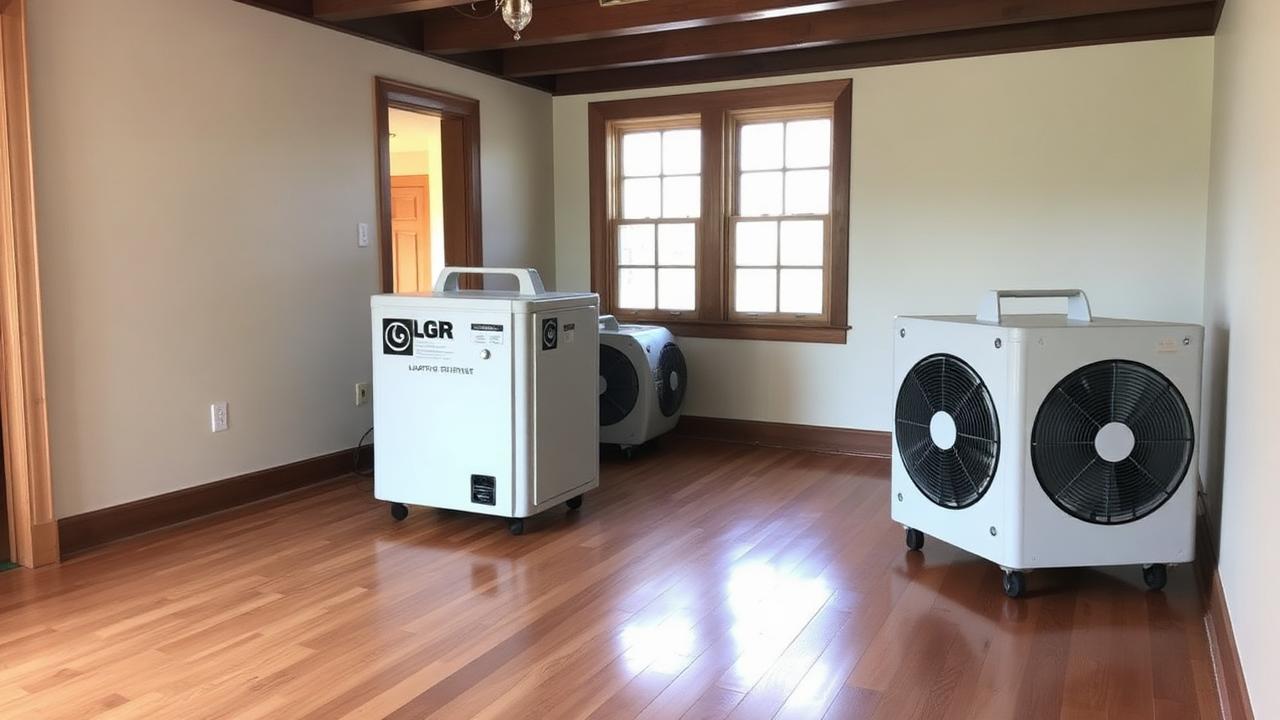
Air mover placement is where drying jobs are quietly won or lost. Too few and the loss drags on; too many and you are eating profit for no gain. Here is how placement works in practice, with the ANSI/IICRC S500 as the reference behind it.
The Baseline Rule
One air mover per 10–16 linear feet of affected wall or per 150–300 sq ft of affected floor, depending on water damage class. Class 4 (deep saturation into low-perm materials) may need one per 50–100 sq ft.
Angle and Direction
- Point air movers at a 10–45° angle into the wall or floor — never straight-on (creates dead spots) and never parallel (no vapor pickup).
- Circulate airflow around the perimeter of the room in one direction. This creates a vortex that keeps moisture-laden air moving toward the dehumidifier's intake.
- Every downstream air mover should pick up where the previous one's throw ends.
Why This Matters for the Dehu Math
Air movers create the vapor pressure differential the dehumidifier removes. Underpowered air movement = dehu running on ambient GPP = long drying times. Overpowered airflow with undersized dehu = mold risk. The two systems have to be sized together — dig deeper in our psychrometry primer.
Field Adjustments
The S500 formula assumes standard 8-ft ceilings and typical materials. Cathedral ceilings need extra air movers directed upward. Hardwood floors need mat-system airflow, not standard perimeter placement — see drying hardwood floors. Chambered environments follow different rules entirely — see building a drying chamber.
Documentation
Every air mover on the invoice needs a placement rationale. A simple floor sketch with air mover locations and CFM ratings answers most adjuster questions upfront. Practice the placement math in our Drying Principles topic quiz.
Test yourself
The quickest way to find out whether this stuck is to answer questions on it cold. Answer the questions before you look anything up — the gap between what you can recall and what you can recognise is the gap that shows up on exam day.
New study material by email
New study guides, tools and practice questions, sent as they are published.
No spam. Unsubscribe anytime.
Related Articles
Ready to Pass the WRT Exam?
300+ practice questions, psychrometric calculators for drying, and study modules built by restoration pros.
Need the standard itself? Purchase the ANSI/IICRC S500 →