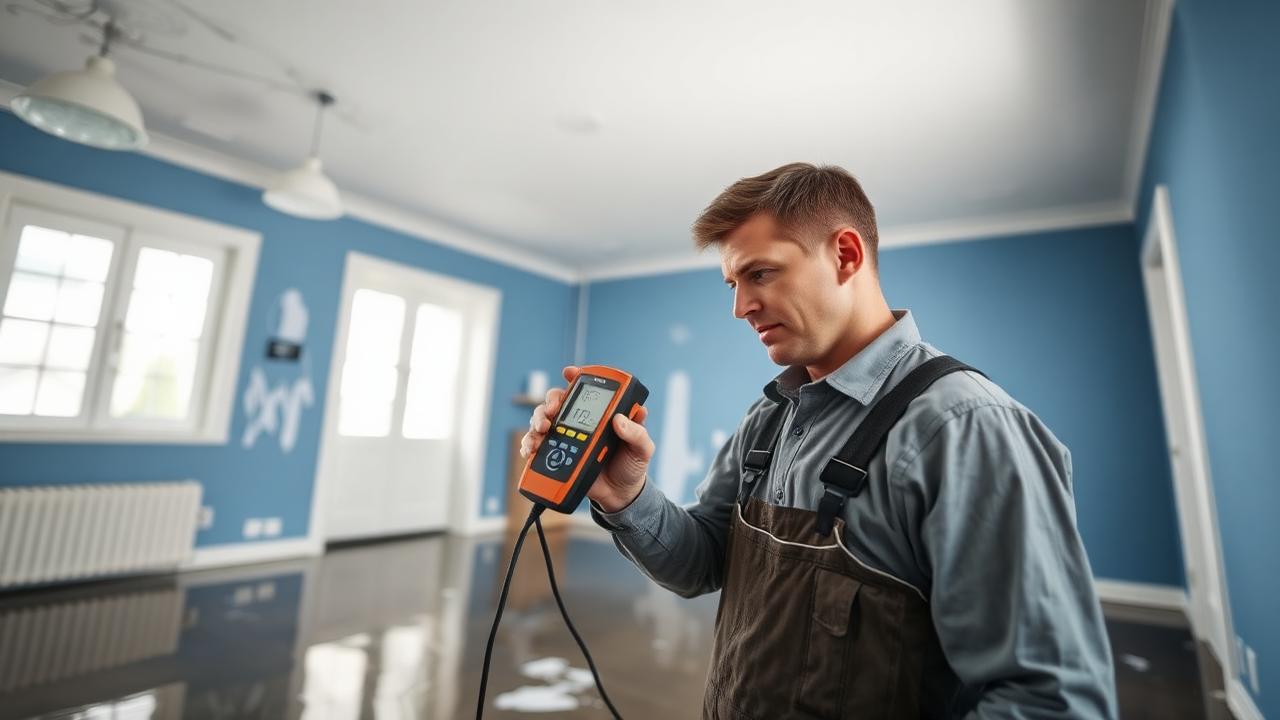
WRT is the credential that gets you on a water loss. AMRT is the one that keeps you legal and defensible when that loss has already grown something. Most technicians take them in that order for a good reason: the IICRC lists WRT as the prerequisite for Applied Microbial Remediation Technician, and almost everything AMRT teaches assumes you already understand psychrometry, category and class.
What is the difference between WRT and AMRT?
WRT covers drying a building before microbial growth takes hold; AMRT covers removing growth that already exists and proving the space is clean afterwards. One is a race against time and vapour pressure. The other is a controlled removal job where the deliverable is a clean, verifiable environment rather than a dry material reading.
That single difference drives everything below. On a WRT job the enemy is moisture, and the tools are extraction, airflow, dehumidification and documentation. On a mold job the moisture problem may be long finished — the enemy is contamination, and the tools are containment, negative pressure, filtration, source removal and clearance. If you want the water-side foundation first, start with IICRC WRT certification and the S500.
When does a water loss become a mold job?
It becomes a mold job the moment visible growth, a suspected hidden reservoir or a condition-2/3 environment is identified — not when a fixed number of days has passed. Time matters, but it is a risk factor, not a trigger. A Category 3 loss sitting in a warm crawl space behaves very differently from a Category 1 supply-line break extracted within hours.
The practical signal is scope change. Once you stop drying materials and start removing them because of what is growing on them, you are running a remediation project, and the documentation, the safety plan and often the contract all change with it. Reviewing water damage categories and classes is worth doing before that call, because category is the language you will use to justify it.
What changes on site?
Containment and airflow direction change first. On a drying job you push air around a space to speed evaporation. On a remediation job you isolate the work area and pull air out of it, so nothing you disturb travels into clean parts of the building.
- Containment — sheeting, zippered entries and sealed penetrations instead of open, cross-ventilated rooms.
- Pressure differential — the work area is held negative to adjacent spaces, exhausted or filtered.
- Air filtration devices — HEPA filtration becomes standard equipment rather than an optional add.
- Air movers — used sparingly and deliberately, because aggressive airflow in a contaminated space is a distribution machine.
- Source removal — the growth and the material carrying it come out; you do not "kill and leave" it.
Equipment sizing changes too, and it is worth checking your numbers with an air changes per hour calculator rather than eyeballing an air scrubber count.
Does the PPE change?
Yes — respiratory protection moves from optional to central. Water work often runs on gloves, boots and eye protection, escalating with category. Remediation work assumes respiratory exposure by default, with the level of protection set by the assessment and the size and condition of the work area.
The related change is the worker side of it: fit testing, medical clearance and a written programme are employer obligations under occupational safety rules in most jurisdictions, not something the technician sorts out on the van. That administrative layer is a real difference between running a drying crew and running a remediation crew.
How does documentation change?
On a water loss you document readings; on a mold job you document control. Both are evidence, but they answer different questions. Drying logs prove materials reached a dry standard. Remediation documentation proves the work area was isolated, the correct engineering controls ran continuously, the source was removed, and the space was verified clean before the containment came down.
Photographs carry a heavier load on remediation projects — containment built, differential in place, pre-removal condition, post-removal condition, HEPA-cleaned surfaces. If you already keep tight drying documentation from your WRT work, you have the habit; you are just recording a different chain of decisions. The daily discipline transfers directly.
What is clearance and why does WRT not have one?
Clearance is an independent verification that the remediated space meets the agreed post-remediation criteria before it is handed back. Drying jobs end when materials reach the dry standard you documented; remediation jobs end when someone confirms the environment is acceptable, and on larger or third-party-directed projects that someone is usually not the contractor who did the work.
That separation between the party doing the work and the party verifying it is one of the genuine mental adjustments coming from the water side. It is also why scope creep is riskier on a mold job: expanding the work area mid-project can change what the clearance is measured against.
Is AMRT harder than WRT?
It is not harder mathematically — it is harder procedurally. WRT leans on psychrometry: GPP, dew point, vapour pressure, grain depression, equipment counts. If you can work a psychrometric chart and size a dehumidifier, you have the hardest part of WRT under control.
AMRT asks fewer chart questions and more "what is the correct sequence, who is responsible, and what must be in place before you cut" questions. The content is broader — biology, health effects, containment engineering, worker protection, clearance — and the answers depend more on the assessment and the written protocol than on a calculation. Candidates who struggle usually struggle with the process order, not the science.
Should you take AMRT next?
Take it if you are already being asked to price, supervise or defend jobs where growth is present. If you spend your weeks on clean-water losses caught early, ASD may serve you better first, because it deepens the drying skill set you already use daily. If Category 3 and long-dwell losses land on your schedule regularly, AMRT is the credential that matches the risk you are already carrying.
Whichever you take, the preparation pattern is the same one that works for WRT: read the standard, work practice questions until the wrong answers stop being tempting, and go into the class with the vocabulary already in your head. You can do the water side free here with the WRT practice test and flashcards, and the mold side at our sister site with the free IICRC AMRT practice test and its S520 guide.
The short version
WRT teaches you to dry a building. AMRT teaches you to remove contamination from one and prove it is gone. The psychrometry carries over, the documentation habit carries over, and the safety discipline gets considerably stricter. If WRT is done, AMRT certification is the logical next step on the IICRC ladder.
Test yourself
The quickest way to find out whether this stuck is to answer questions on it cold. Answer the questions before you look anything up — the gap between what you can recall and what you can recognise is the gap that shows up on exam day.
New study material by email
New study guides, tools and practice questions, sent as they are published.
No spam. Unsubscribe anytime.
Related Articles

Ready to Pass the WRT Exam?
300+ practice questions, psychrometric calculators for drying, and study modules built by restoration pros.
Need the standard itself? Purchase the ANSI/IICRC S500 →