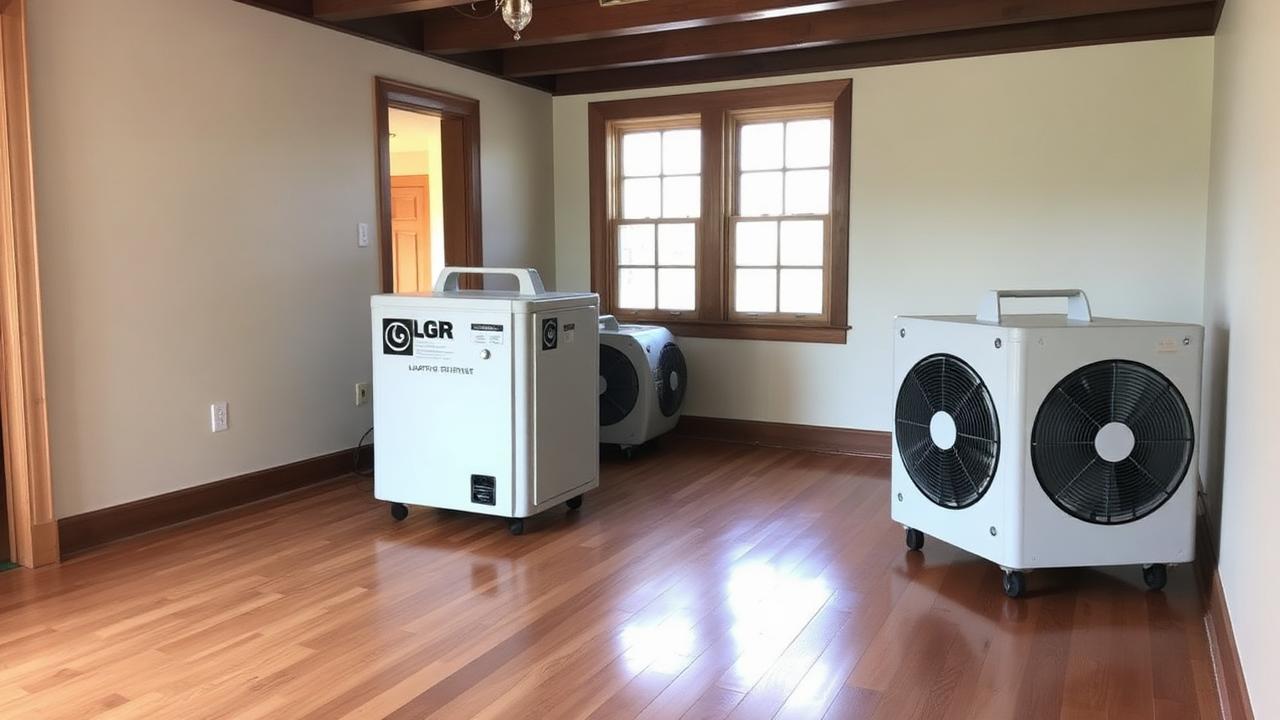
Choosing the right dehumidifier isn't just about grabbing the biggest unit off the truck. LGR (Low Grain Refrigerant) and conventional refrigerant dehumidifiers serve different purposes, and the S500 standard expects you to know when to deploy each type. It's also worth knowing cold before the WRT exam.
How Conventional Dehumidifiers Work
Conventional refrigerant dehumidifiers pull humid air across a cold coil, condensing moisture which drains into a collection system. They work well when GPP levels are high. In early-stage drying when the air is heavily moisture-laden, conventional units are efficient and cost-effective.
Their limitation: conventional units lose capacity as grain levels drop, and each unit's performance chart shows where. The coils can't get cold enough to condense the lower moisture content, and the unit essentially recirculates air without removing much water.
How LGR Dehumidifiers Work
LGR units pre-cool incoming air before it reaches the primary cooling coil, so they keep removing water at lower grain levels than conventional units — each unit's performance chart shows how low. This makes them essential for the later stages of drying when you're trying to reach your final drying goals. They're more expensive to purchase and operate, but they finish the job.
When to Use Each Type
Here's the practical decision framework:
- High grain levels: Conventional dehumidifiers work well and are more cost-effective
- Falling grain levels: LGR units keep removing water as conventional units lose capacity — the performance charts show where each unit falls off
- Low grain levels: LGR is essential — conventional units remove little water at these levels
- Cold environments (below 65°F): LGR units perform better; conventional units may ice up
Many experienced technicians start with conventional units during the first 24 hours of heavy extraction, then swap to LGR units once initial moisture levels drop. Use our GPP calculator to monitor when to make the switch.
Placement and Airflow
Dehumidifier placement matters as much as selection. Position units centrally in the drying area, away from walls. Ensure air movers are directing evaporated moisture toward the dehumidifier intake. The S500 specifies equipment ratios based on water damage class — higher classes require more dehumidification capacity per square foot.
When is a desiccant the right call?
Reach for a desiccant when the air must go drier or colder than a refrigerant unit can usefully manage. Instead of condensing moisture on a cold coil, a desiccant passes air over a moisture-attracting medium and exhausts the collected water as wet air, so its performance does not collapse as the space gets cold.
That makes desiccants the usual answer for unheated structures in winter, for Class 4 losses where bound water in plaster, hardwood or concrete needs a very low vapour pressure to move, and for large open commercial spaces where one ducted unit replaces a row of refrigerant machines. The trade-offs are real: you need to duct process and reactivation air, you need somewhere to exhaust wet air outside the drying chamber, and running cost and setup time are higher.
Practically, a desiccant is a decision rather than a default. If refrigerant units are holding the chamber at a workable grain depression and materials are still losing moisture day on day, stay as you are. If the grain depression has flattened, materials have stalled and the space is cold, that is the point to change technology rather than add more of the same. Check the numbers first with the dehumidifier sizing tab of the GPP calculator and log the change in your drying log, then read Class 4 water damage for the specialty-drying context.
What shows up on the exam?
Expect questions about dehumidifier selection. Know how to read a unit's performance chart, understand why an LGR outperforms a conventional unit at low grain levels, know the basic operating principle of each type, and know when a desiccant is preferred. Review the exam preparation guide for more strategy.
Test yourself
The quickest way to find out whether this stuck is to answer questions on it cold. Answer the questions before you look anything up — the gap between what you can recall and what you can recognise is the gap that shows up on exam day.
Test Your Knowledge
Try these practice questions related to this article.
1. What happens to a conventional dehumidifier's capacity as the grain level in the room drops?
2. What advantage do LGR dehumidifiers have over conventional units?
3. When might a desiccant dehumidifier be the best choice?
New study material by email
New study guides, tools and practice questions, sent as they are published.
No spam. Unsubscribe anytime.
Related Articles

Ready to Pass the WRT Exam?
300+ practice questions, psychrometric calculators for drying, and study modules built by restoration pros.
Need the standard itself? Purchase the ANSI/IICRC S500 →