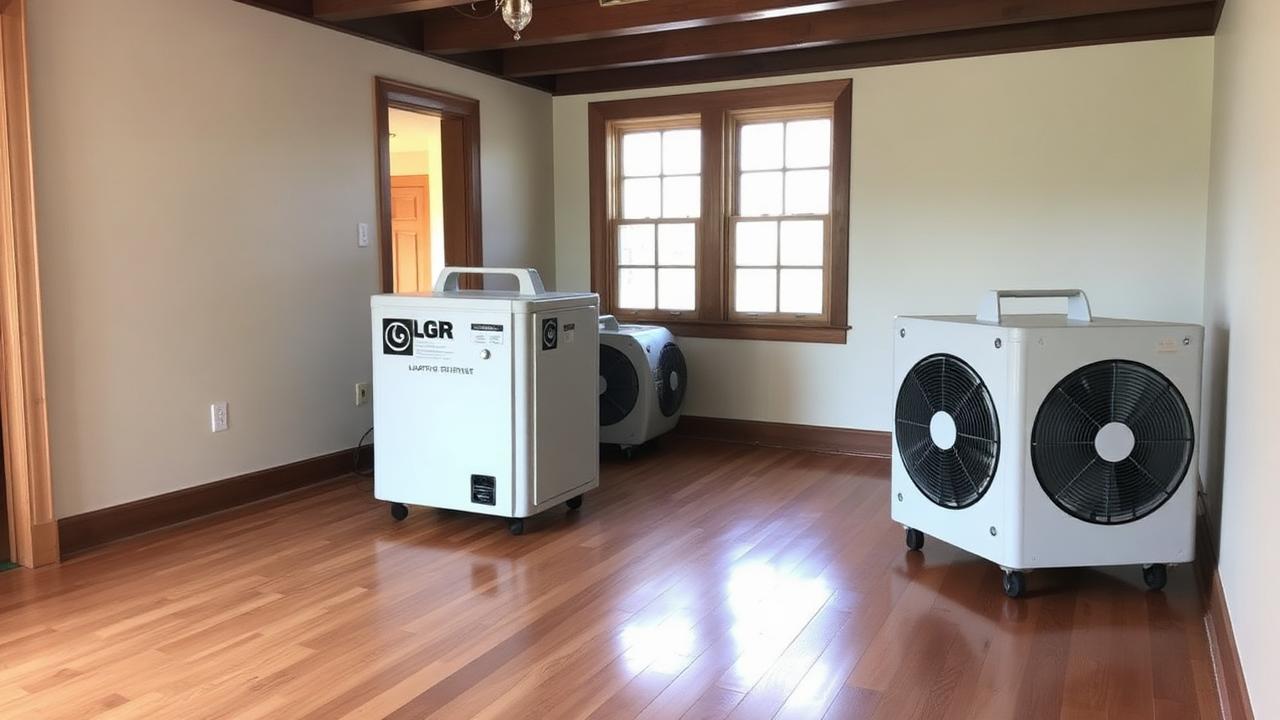
Every technician meets a Class 4 loss eventually and most of them meet it late, after two days of wondering why the readings will not move. The materials involved do not release water on the timescale the rest of the job runs on, and the fix is a change of method rather than a change of equipment count.
What is Class 4 water damage?
Class 4 is the classification for losses dominated by low-permeance, low-porosity materials that hold water tightly and release it slowly. The wet area may be small and the water volume modest; what makes it Class 4 is where the water has gone, not how much of it there is.
It is the one class where the obvious response — add air movers — is the wrong instinct. Air movement can only take away water that has reached a surface. When the water is held inside the material, the constraint is the rate at which it migrates outward, and that rate responds to the vapour pressure difference you create, not to wind speed. The categories and classes hub sets out how this class sits against the others.
What is bound water?
Bound water is water held within the structure of a material rather than sitting free in its pores, and it leaves only when the surrounding air is dry enough to pull it out. Free water evaporates readily; bound water has to migrate to the surface first, and that migration is slow and gets slower as the material dries.
This is why a hardwood floor can read wet for days after the surface feels bone dry to the hand, and why a reading taken at the surface can be misleading. Depth matters: a pin meter set into the board tells a different story from a non-penetrating meter sitting on the finish, and on a Class 4 job the difference between those two readings is the job.
Which materials behave this way?
Dense, tight, mineral or hardwood assemblies are the usual suspects. Hardwood flooring and subfloor sandwiches, plaster over lath, concrete slabs, gypsum-based underlayments, brick, stone, and any assembly where a vapour-retarding layer is trapping moisture behind it.
Assemblies matter more than individual materials. A hardwood floor glued to a slab over a vapour barrier is a Class 4 problem even if the hardwood alone would not be, because the water has nowhere to leave except upward through the finish. Identifying the assembly on day one — and photographing it — saves an argument about scope later.
Test yourself
Bound water, vapour pressure and specialty drying come up constantly in class and category questions. Answer the questions before you look anything up — the gap between what you can recall and what you can recognise is the gap that shows up on exam day.
How does specialty drying work?
You create and hold a large vapour pressure difference between the material and the air, then wait, then verify. Very dry air next to a wet material is what drives bound water out; the drier you hold the air, the steeper the gradient and the faster the migration.
Two techniques do most of the work. The first is deep dehumidification — holding the space at a much lower grain count than a normal drying chamber, often with desiccant equipment, because a refrigerant machine's performance falls away as air gets dry and cold. The second is directed drying: mat systems, injection and panel systems that deliver airflow into or across the specific assembly instead of into the room, so the gradient is applied where the water actually is. Containment matters more than usual here, because you cannot hold very low humidity in a space open to the rest of the building. The structural drying guide covers how those principles fit together.
Why does it take so long?
Because the material sets the pace, and the pace slows as the material dries. The last few percentage points of moisture content are always the slowest, since the remaining water is the most tightly held and the gradient driving it out is the smallest.
What that means commercially is that a Class 4 job needs its expectations set on day one, in writing, with the adjuster and the property owner. Nobody who was told "three days" reacts well to day nine, even when day nine is the correct answer for a glued hardwood floor over a slab. Explaining the mechanism early — the water is inside the wood, and it comes out at the speed the wood allows — buys the patience the job needs. Never publish a fixed day count for a Class 4 loss; state the mechanism and show the trend line instead.
How do you document a long job?
With a daily trend, not a pair of readings, because on a slow job the trend is the only proof that the method is working. Two readings a week apart can be argued with; fourteen readings showing a steady decline cannot.
Record the psychrometrics of the chamber, the moisture content of each mapped point, the dry standard taken from an unaffected assembly of the same material, and the equipment on site each day. Equipment unit-days are what the invoice is built from, and on a long job they are also the thing most likely to be questioned. The drying log and mitigation report template tracks readings and unit-days together and prints as one file, and the moisture mapping template keeps the points tied to a room diagram.
New study material by email
New study guides, tools and practice questions, sent as they are published.
No spam. Unsubscribe anytime.
Related Articles

Ready to Pass the WRT Exam?
300+ practice questions, psychrometric calculators for drying, and study modules built by restoration pros.
Need the standard itself? Purchase the ANSI/IICRC S500 →