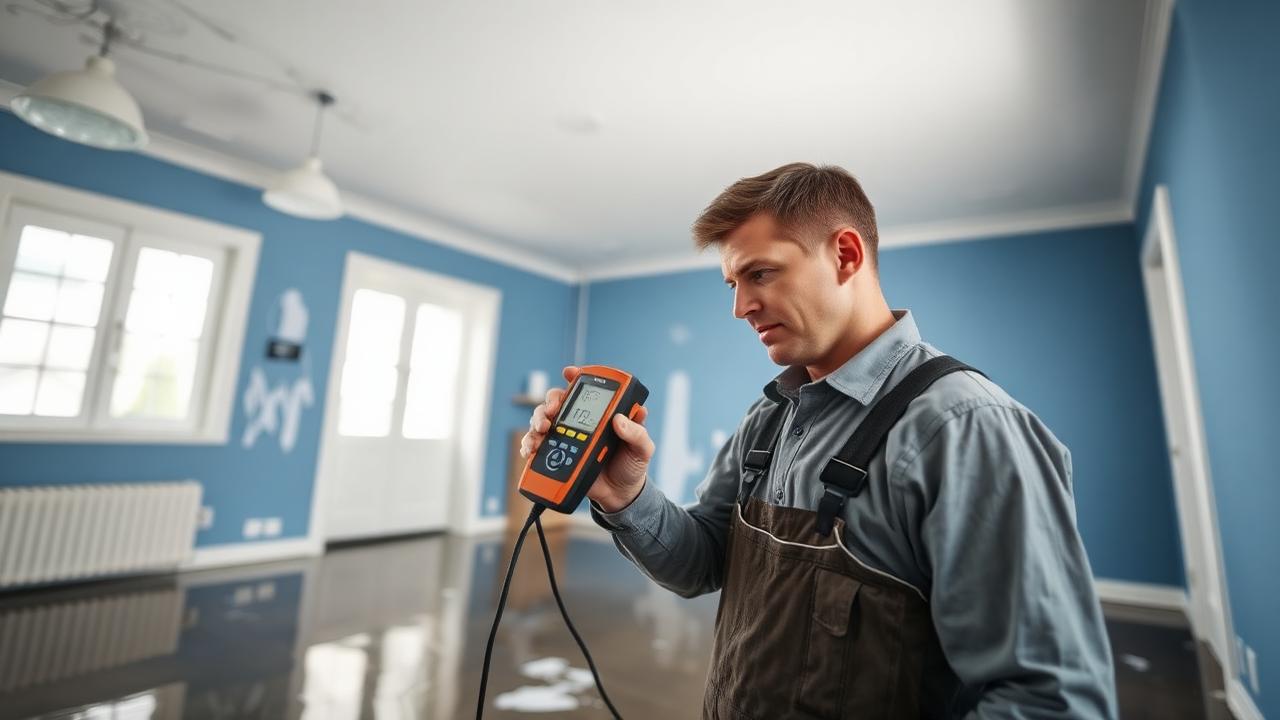
Your moisture meter is the most important tool on a water damage job — it tells you where water is, how bad the damage is, and when drying is complete. But meters don't read "wet" or "dry" — they give you numbers that need interpretation. Understanding those numbers separates professional restoration from guesswork. The S500 standard requires documented moisture readings throughout every drying project.
Pin-Type vs. Pinless Meters
Pin-type meters use two metal pins inserted into the material to measure electrical resistance between them. Wetter material conducts more electricity, giving a higher reading. They're accurate for wood and provide depth-specific readings but leave small holes in the material.
Pinless (non-invasive) meters use electromagnetic signals to scan for moisture without penetrating the surface. They cover more area quickly and are ideal for initial assessment and scanning walls, floors, and ceilings. However, they can be affected by metal pipes, foil-faced insulation, and other dense materials behind the surface.
Best practice: use a pinless meter for rapid scanning to find wet areas, then verify with a pin-type meter for accurate readings at specific locations. Both types are covered on the WRT exam.
Establishing a Dry Standard
Before you start drying, take readings in an unaffected area of the same building using the same material type. This is your "dry standard" — the baseline moisture content that the affected areas need to reach. The S500 defines drying goals relative to this standard, not to an arbitrary number.
For example, if unaffected drywall reads 0.4% on a pin meter, your drying goal for affected drywall is at or near 0.4%. Different materials have different normal moisture contents — wood typically reads 7-14% in normal conditions, while drywall reads much lower.
Material-Specific Readings
Many moisture meters have material-specific settings or correction scales:
- Wood: Most meters are calibrated for Douglas fir. Other wood species may need correction factors from the manufacturer's chart
- Drywall: Use the drywall or gypsum setting and compare readings with your dry standard rather than a fixed number
- Concrete: Requires specialized meters or calcium chloride testing for accurate readings; standard pin meters don't work reliably
- Carpet and pad: Pinless meters in "carpet mode" if available, or use a penetrating probe through the carpet
Common Mistakes
The most common errors restoration technicians make with moisture meters:
- Not calibrating the meter before use — most meters have a calibration check built in
- Reading through wet surfaces — a wet carpet over dry subfloor will fool a pinless meter
- Ignoring the depth of reading — pin meters read between the pins only; pinless meters scan to a specific depth
- Using the wrong material setting — reading drywall on a wood setting gives meaningless numbers
- Not establishing a dry standard first — you can't determine "dry" without a reference point
Documenting Readings
The S500 requires moisture readings at initial assessment and at regular intervals during drying. Create a moisture map showing reading locations and values. Use consistent grid points so you can track trends. Document readings alongside temperature and humidity data for complete insurance documentation.
For exam preparation, make sure you understand both meter types, dry standards, and documentation requirements. Practice with our WRT exam simulator.
Test yourself
The quickest way to find out whether this stuck is to answer questions on it cold. Answer the questions before you look anything up — the gap between what you can recall and what you can recognise is the gap that shows up on exam day.
Test Your Knowledge
Try these practice questions related to this article.
1. What is a 'dry standard' in moisture measurement?
2. Which type of moisture meter is best for rapid initial scanning of large areas?
3. What can cause a false high reading on a pinless moisture meter?
New study material by email
New study guides, tools and practice questions, sent as they are published.
No spam. Unsubscribe anytime.
Related Articles

Ready to Pass the WRT Exam?
300+ practice questions, psychrometric calculators for drying, and study modules built by restoration pros.
Need the standard itself? Purchase the ANSI/IICRC S500 →