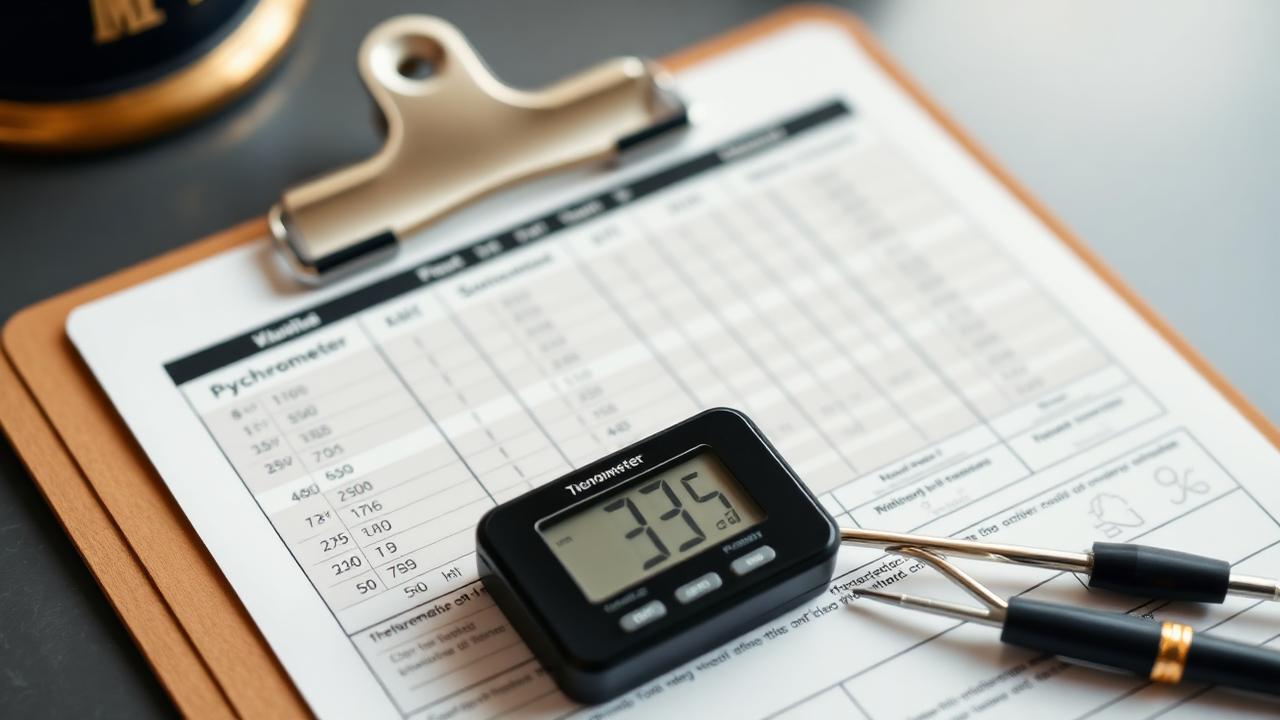
If there's one topic that quietly fails more WRT candidates than any other, it's psychrometry. It looks like physics, the chart looks intimidating, and most prep guides gloss over it. But once you understand what psychrometry actually is — the relationship between air, temperature, and water vapor — every drying decision on every job makes sense. And the S500 assumes you know it.
Psychrometry in One Sentence
Psychrometry is the study of how air holds water vapor and how that relationship changes with temperature. Warm air can hold more moisture than cold air — that's the entire foundation. Every dehumidifier, every air mover, every drying decision is downstream of that one fact.
Try it yourself right now with our free psychrometric chart and GPP calculator — punch in a temperature and humidity and watch the dew point and grains per pound update live.
The Five Measurements You Must Know
The WRT exam expects fluency with five interrelated measurements. Confuse them and you'll lose easy points.
- Dry-bulb temperature: The plain air temperature your thermometer shows.
- Relative humidity (RH): The percentage of moisture the air is holding relative to its maximum capacity at that temperature. RH changes when temperature changes even if no water is added or removed — this is why RH alone is a misleading drying metric.
- Grains per pound (GPP): The actual weight of water vapor per pound of dry air. Unlike RH, GPP doesn't lie when temperature shifts. The S500 wants you making decisions in GPP, not RH.
- Dew point: The temperature at which air becomes saturated and condensation forms. Critical for preventing secondary damage on cold surfaces.
- Vapor pressure: The "push" of water vapor in the air. Moisture moves from high vapor pressure to low. This is the engine of drying.
Why the S500 Insists on GPP
Imagine a room reading 70°F / 60% RH. You heat it to 90°F without adding or removing moisture. The RH drops to about 32% — looks like progress. But the GPP didn't move an inch. The air contains the exact same amount of water. If you made drying decisions based on RH, you'd think you were winning when you weren't. LGR dehumidifier selection hinges on GPP, not RH — see our breakdown for how each type performs as grain levels fall.
Reading the Psychrometric Chart
The psychrometric chart looks like spaghetti the first time you see it. It isn't. There are only five things on it: dry-bulb temperature (bottom), humidity ratio / GPP (right side), relative humidity curves (the swooping lines), wet-bulb temperature (diagonal lines), and dew point (left side curve). Find any two values you know and every other property of that air sample is a finger trace away.
The exam will ask you to identify what changes when you heat air, cool air, or add moisture. Practice with our interactive psychrometric chart until the relationships are automatic.
Practical Drying: Moisture Moves From High to Low
Wet materials have high vapor pressure on the surface. Dry air has low vapor pressure. Moisture migrates from the material into the air — but only as long as the air can still accept it. The moment the air saturates, drying stops. That's why structural drying is a balance of three things: heat (raises the air's capacity), airflow (replaces saturated air at the surface), and dehumidification (removes water from the air so it stays thirsty).
Dew Point and Secondary Damage
If your dew point is 58°F and a wall surface is sitting at 55°F, you're growing condensation on that wall. Cold ducts, north-facing exterior walls, and concrete floors are common cold spots. Always know your dew point — it's printed right next to GPP on every thermo-hygrometer worth owning. Mold prevention starts here.
How Psychrometry Shows Up on the WRT Exam
Expect questions touching psychrometry, including:
- Calculating GPP from temperature and RH (or being given GPP and asked to interpret it)
- Predicting how RH changes when you heat or cool a space
- Identifying whether a dehumidifier is making progress (compare inlet vs outlet GPP)
- Recognizing dew point risks for secondary damage
- Reading values off a psychrometric chart
Drill these with our timed practice exam and the flashcards for the WRT exam — the psychrometry deck alone covers every term above.
From Theory to Test Day
Don't try to memorize the chart. Understand the relationships, then practice until they're reflex. Hands-on classroom time accelerates this — find an in-person WRT course near you in our class directory. Combine that with steady practice questions and you'll walk into test day with psychrometry as a strength instead of a fear.
Test yourself
The quickest way to find out whether this stuck is to answer questions on it cold. Answer the questions before you look anything up — the gap between what you can recall and what you can recognise is the gap that shows up on exam day.
New study material by email
New study guides, tools and practice questions, sent as they are published.
No spam. Unsubscribe anytime.
Related Articles

Ready to Pass the WRT Exam?
300+ practice questions, psychrometric calculators for drying, and study modules built by restoration pros.
Need the standard itself? Purchase the ANSI/IICRC S500 →