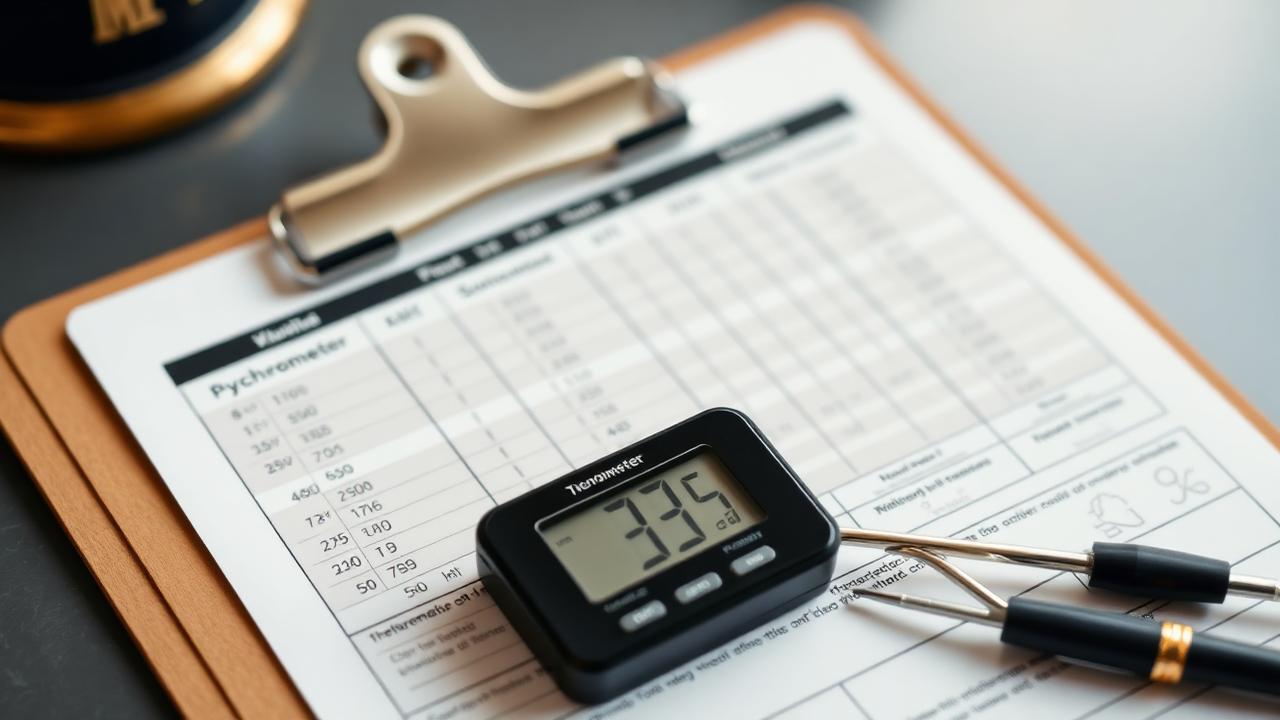
The psychrometric chart looks like spaghetti until someone shows you the five lines that matter. Once you can plot a point and slide along the right axes, half the psychrometry questions on the WRT exam become trivial. If you're new to the concepts, start with what is psychrometry and psychrometry basics.
The Five Lines You Need
- Dry bulb temperature — bottom horizontal axis, straight vertical lines going up.
- Relative humidity — curved lines running left-to-right. 100% RH is the saturation curve on the upper left.
- Humidity ratio (GPP) — right vertical axis, straight horizontal lines running left.
- Dew point — read on the saturation curve; travel horizontally left from your plotted point until you hit the curve.
- Wet bulb temperature — diagonal lines running upper-left to lower-right at roughly 30°.
How to Plot a Point
You need any two of the five values. Most common in the field: dry bulb + RH. Find your dry bulb temperature on the bottom, go straight up. Find your RH curve, follow it. Their intersection is your air's current state.
Reading GPP From That Point
Travel horizontally to the right — where you hit the right axis is your GPP (grains per pound). This is the number that matters for dehumidifier sizing. Play with our free psychrometric chart tool to see it live.
Reading Dew Point
From the same point, travel horizontally to the left until you hit the saturation curve. Drop straight down to the bottom axis — that's your dew point. This tells you the temperature at which condensation forms.
Why Restoration Cares
- Comparing indoor GPP to outdoor GPP tells you whether to ventilate or dehumidify — see setting drying goals.
- Dew point predicts secondary damage on cold surfaces.
- Wet bulb depression tells you how much evaporative cooling you can get from an air mover.
Practice Problem (Common WRT Exam Format)
Indoor air is 78°F at 65% RH. What's the GPP? Plot it: 78°F straight up, 65% RH curve, travel right to about 92 GPP. Compare it with the same reading from an unaffected area: the gap is what the drying still has to close.
Further Reading
ASHRAE's psychrometry resources are the deep-dive reference. For exam-focused drills, run the Psychrometry topic quiz or the full WRT practice exam.
Test yourself
The quickest way to find out whether this stuck is to answer questions on it cold. Answer the questions before you look anything up — the gap between what you can recall and what you can recognise is the gap that shows up on exam day.
New study material by email
New study guides, tools and practice questions, sent as they are published.
No spam. Unsubscribe anytime.
Related Articles

Ready to Pass the WRT Exam?
300+ practice questions, psychrometric calculators for drying, and study modules built by restoration pros.
Need the standard itself? Purchase the ANSI/IICRC S500 →