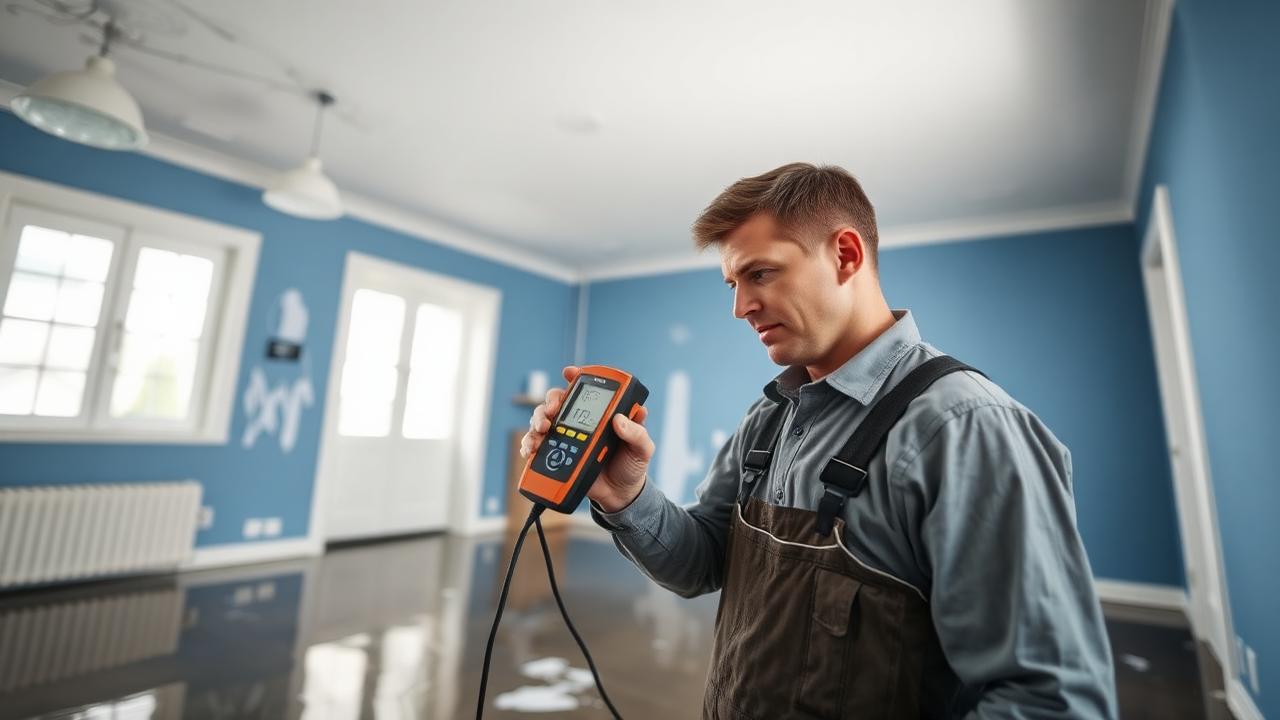
Thermal imaging is the most-oversold tool in restoration. It doesn't detect water — it detects temperature differentials that often correlate with evaporative cooling from wet materials. Big difference. Here's how to use it correctly.
What the Camera Actually Shows
All the IR camera sees is surface temperature. Wet materials evaporate, evaporation cools the surface, and cool surface = darker on your IR display. But so does an HVAC vent blowing on that wall, a thermal bridge at a stud, or a shadow that just moved off the wall. Always confirm suspected wet areas with a pin or pinless moisture meter.
When Thermal Imaging Works Best
- Initial scoping — quickly identify areas to probe with a moisture meter.
- Ceiling losses — where you can't easily pinless-scan every square foot.
- Progress monitoring — comparing day-1 and day-3 images to visualize drying.
When It Lies
- Recent sun exposure on exterior walls (warms surface, masks wet spots).
- HVAC-conditioned surfaces (cold air return above suspected wet area = false positive).
- Reflective surfaces (stainless, tile, glossy paint) — IR reflects, doesn't read.
Camera Specs That Matter
For restoration work, look for a sensor of at least 160×120 with thermal sensitivity ≤0.1°C. Higher-end 320×240 sensors (FLIR E5-XT, FLIR E8-XT, Seek Reveal Pro) pay for themselves on commercial losses. See our 2026 moisture meter roundup for the meters we pair with IR.
Documentation Value
IR images with side-by-side visible photos are gold with adjusters. Timestamp every capture and reference it against your daily documentation. Learn more about IR fundamentals from FLIR's thermography primer.
Ready to test what you've learned? Take a topic quiz on equipment and detection tools.
Test yourself
The quickest way to find out whether this stuck is to answer questions on it cold. Answer the questions before you look anything up — the gap between what you can recall and what you can recognise is the gap that shows up on exam day.
New study material by email
New study guides, tools and practice questions, sent as they are published.
No spam. Unsubscribe anytime.
Related Articles
Ready to Pass the WRT Exam?
300+ practice questions, psychrometric calculators for drying, and study modules built by restoration pros.
Need the standard itself? Purchase the ANSI/IICRC S500 →