
If you've been losing sleep over the IICRC WRT exam, take a breath. It's a technical exam — not a trick exam. Candidates who prepare seriously pass it. Candidates who treat the class alone as the whole prep often don't. Here's a realistic look at what makes it hard and what doesn't.
The Numbers
The IICRC does not publish pass rates, and it does not publish the question count, time limit or passing score for the WRT exam on its course page, so we do not either — confirm the current format with your approved school or at iicrc.org. What we can tell you is how our own simulator works: it is timed, answers lock once committed, and it marks a pass at 72%.
What Actually Makes It Hard
Three things trip up most candidates:
- Psychrometry. If you walk in without a working understanding of GPP, RH, and dew point, you'll guess on the psychrometry questions. See our psychrometry basics and the why-the-exam-tests-it deep-dive.
- Category vs Class confusion. Categories describe water contamination (1, 2, 3). Classes describe absorption (1–4). They are independent. Read our category breakdown and classes guide.
- Counting on going back. Don't plan on returning to a question: if you're used to tagging questions and circling back, practice committing to each answer the first time you read it.
What Isn't As Hard As It Seems
Most candidates over-estimate the difficulty of memorizing equipment specs and under-estimate the importance of understanding why things work. The S500 isn't trying to trick you. If you understand the principles, you can reason through unfamiliar questions.
Who Passes on the First Try
The first-time passers we've talked to share four habits:
- They took at least 3 full timed practice exams before test day
- They could explain GPP and dew point to a 12-year-old
- They knew the difference between LGR and conventional dehumidifiers without thinking — see our breakdown
- They had a study plan (like our 2-week study plan) rather than "I'll read the workbook and hope"
Who Tends to Struggle
Candidates who:
- Treat the 3-day class as the only preparation
- Skip psychrometry because "I'll never use that on a job" (you will, constantly)
- Don't take a single timed practice exam before test day
- Confuse memorizing answers with understanding concepts
Compared to Other IICRC Exams
WRT is generally considered easier than AMRT (mold remediation has more regulatory and procedural memorization) and about equal to ASD (Applied Structural Drying assumes WRT knowledge and adds hands-on lab). See our full comparison of WRT vs ASD vs AMRT.
How to De-Risk Your Attempt
The single highest-leverage thing you can do: take timed practice exams. They reveal weak topics, build endurance, and remove the surprise factor on test day. Start with our free practice exam, drill weak topics with the flashcard system, and use the psychrometric chart and GPP calculator until those concepts are reflex.
One More Thing About the Course Itself
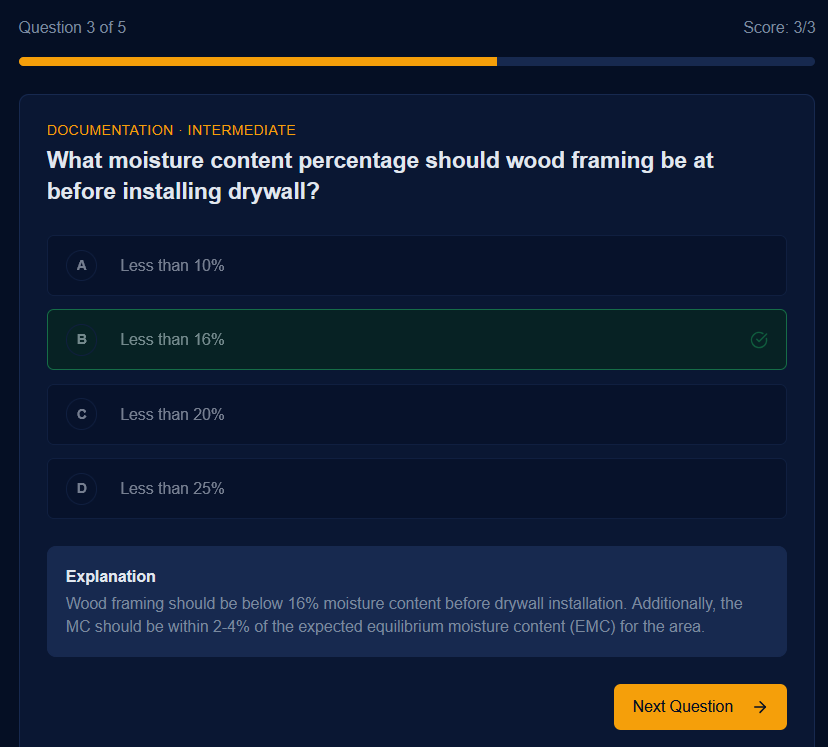
If you can attend the in-person IICRC course rather than online, do it. Watching an instructor demonstrate equipment and walk through psychrometric chart readings makes the material stick in a way reading never will. Find a class in your state through our IICRC class directory.
The WRT exam is hard enough to weed out the unprepared. With a focused study plan it is comfortably passable on the first try. Take a free practice exam now and see how close you already are.
Test yourself
The quickest way to find out whether this stuck is to answer questions on it cold. Answer the questions before you look anything up — the gap between what you can recall and what you can recognise is the gap that shows up on exam day.
New study material by email
New study guides, tools and practice questions, sent as they are published.
No spam. Unsubscribe anytime.
Related Articles
Ready to Pass the WRT Exam?
300+ practice questions, psychrometric calculators for drying, and study modules built by restoration pros.
Need the standard itself? Purchase the ANSI/IICRC S500 →