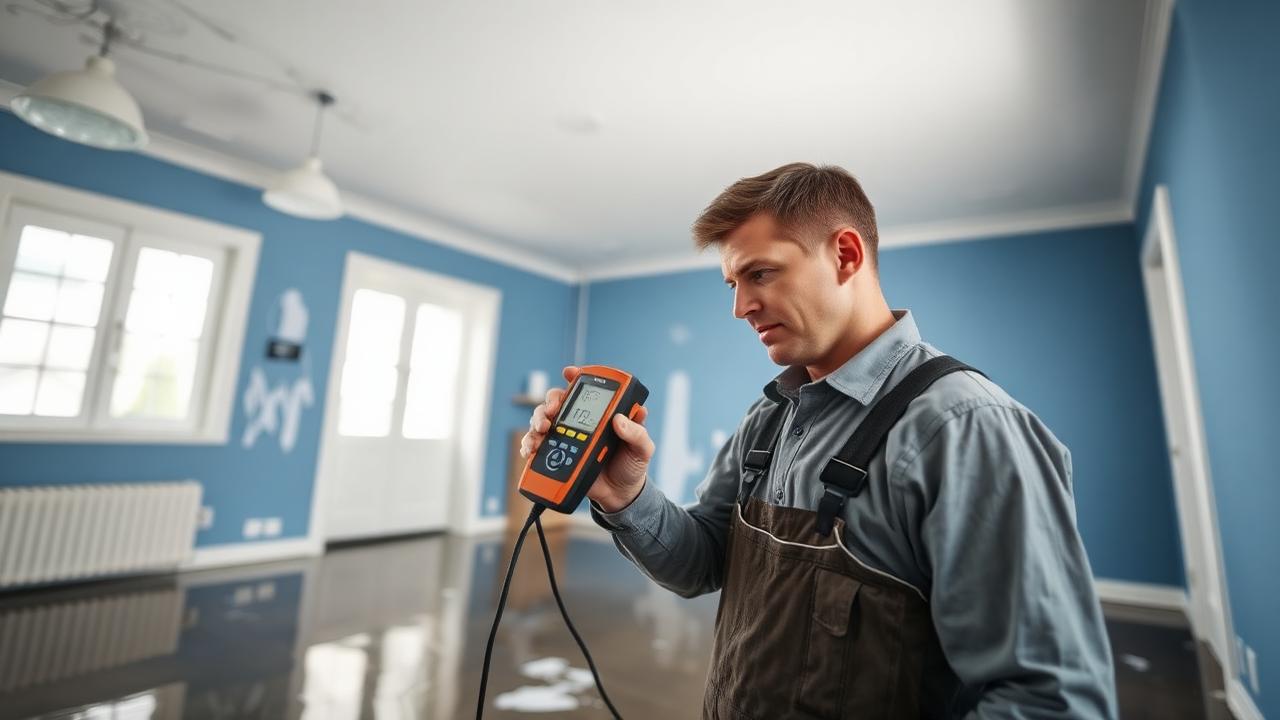
Restoration hires people with no background in it every week, trains them on the truck, and certifies them afterwards. That makes it unusually open — and unusually easy to misjudge before you start.
What does a restoration technician actually do?
You respond to water losses, extract, set drying equipment, monitor readings daily and document everything for the claim. The job is part physical work, part instrument reading, part paperwork, and the paperwork is what separates a technician from a helper.
A typical loss starts with an emergency call, an inspection and moisture mapping, then extraction and equipment placement the same visit. You return each day, take readings, compare them with yesterday's, adjust equipment and record the result until materials reach the drying goal. The moisture mapping template and drying log show the shape of that daily record.
What do you earn?
Pay varies by region, employer, experience and certifications, so ask employers in your own market rather than trusting a national figure. We do not publish salary numbers here because any range we quoted would be wrong for most readers.
What is consistent is the structure: entry-level work, then a certified technician role, then crew lead, then project management or estimating, then branch management or ownership. Overtime and catastrophe deployments change the picture considerably, in both directions.
Which certifications matter?
The water damage restoration technician credential is the starting point, and most other restoration credentials assume it. The syllabus is drawn from the ANSI/IICRC S500 — categories and classes, psychrometry, drying principles and safety.
- WRT — water damage restoration technician; see the WRT certification guide.
- ASD — applied structural drying; see the ASD certification guide.
- AMRT — applied microbial remediation, for mold work; see AMRT certification on our sister site.
- OSHA 10/30 — general safety training, commonly asked for by employers.
Keeping a credential current means an annual renewal fee and 14 CEC hours every four years, as listed on the IICRC FAQs; the mechanics are in the renewal guide.
How do you get started with no experience?
Apply first, study in parallel, and book the class once someone has hired you or agreed to sponsor it. Most employers train on the job and expect certification within the first year rather than on day one.
- Apply to restoration firms in your area — emergency-response work turns over constantly.
- Start on the fundamentals now with the study modules.
- Work the practice exams until category, class and psychrometry stop costing you questions.
- Find a scheduled class in the class directory and register.
- Read how to pass the exam first time before you sit it.
What are the hours really like?
Water losses do not wait for business hours, so after-hours calls, weekends and storm-season stretches are part of the job. If that is a dealbreaker, it is better to know before you start than after.
The upside is variety and speed of progression: a technician who volunteers for the awkward jobs and documents them properly moves up quickly, because good documentation is rarer than good extraction.
What should you learn first?
Category and class, psychrometry, and drying goals — in that order. They decide what you remove, what you dry and when you stop, which is most of the decision-making on a loss.
Start with water damage categories and classes, then structural drying, then run real readings through the psychrometric calculators.
Test yourself
The quickest way to find out whether this stuck is to answer questions on it cold. Answer the questions before you look anything up — the gap between what you can recall and what you can recognise is the gap that shows up on exam day.
Test Your Knowledge
Try these practice questions related to this article.
1. According to the post, what separates a technician from a helper?
2. Which IICRC certification is considered the foundation credential for restoration careers?
3. Do you need a college degree to start a career in water damage restoration?
New study material by email
New study guides, tools and practice questions, sent as they are published.
No spam. Unsubscribe anytime.
Related Articles

Ready to Pass the WRT Exam?
300+ practice questions, psychrometric calculators for drying, and study modules built by restoration pros.
Need the standard itself? Purchase the ANSI/IICRC S500 →